
“For artists, the great problem to solve is how to get oneself noticed.” – Honoré de balzac
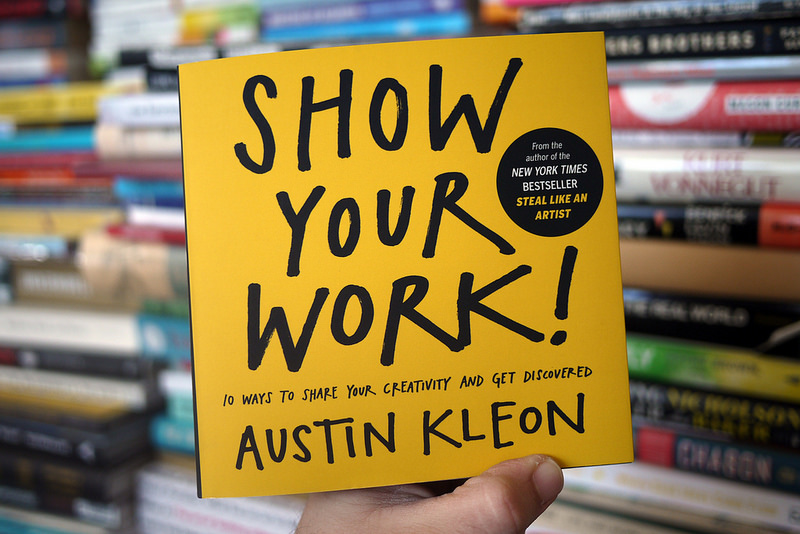
In this book Austin Kleon learns us how you can put yourself out there as an artist or if you want to share something with the world. He learns us to share our process, ideas, thoughts and all the other crap that lays on your desk.
This book is divided into 10 ways. 10 ways to share your creativity.

1. You don’t have to be a genius
Be an Amateur. This maybe sounds weird to you but in the book Kleon tells us that sometimes, amateurs have more to teach us than an expert. An amateur has an beginners mind. He thinks in more ways. An expert don’t.
“In the beginner’s mind, there are many possibilities,” said Zen monk Shunryu Suzuki. “In the expert’s mind, there are few.”

learn to use your voice! A lot of people struggle with this but the only way to find your voice is to use it. It is build into you.
2. Think process, not product
Take people behind the scenes. The time where artists hid themselves away for years and then come out with a masterpiece is long gone. The internet has changed this. People really do want to see how the sausage gets made. Audiences want to see the person behind the product. and the things they do in their lives

Become a documentarian of what you do. Start a work journal: write down your thoughts in a notebook, make a scrapbook, make pictures, take a lot of photographs. This isn’t about making art. This is about simply keeping track of what’s going on around you.
3. Share something small everyday
“Will this potentially help at least one person in the world? If so, I should share it.”
90% of everything you find out there is crap. The same is true for your own work. Just get these things out there and you’ll see how people react. The form doesn’t matter just share it.
If there is only one thing you will get out of this book it is this: Go register a domain name, build a website. It doesn’t have to look pretty or have all this nice buttons and features. No the most important thing is that it exists.
Fill your website with your work. You can do whatever you want with it. Its yours. Whether people show up or they don’t, you are out there. Everyone can see your work there. It will be the best investment in the long run.
4. Open up your cabinet of curiosities
Share other people’s work. We all like different things. If you can share the stuff you like, if you can curate it for others, good things will happen. Share other people’s work, curate stuff, remarkable objects. Everyone has something they collect. Show it.
Credit is always due, if you’re sharing other people’s work, you want to credit them.
“Another form of attribution that we often neglect is where we found the work that we’re sharing. It’s always good practice to give a shout-out to the people who’ve helped you stumble onto good work and also leave a bread-crumb trail that people you’re sharing with can follow back to the sources of your inspiration’”
The number one rule on the internet: people are lazy. If you don’t include a link no one can click it. It makes it useless. No one is going to google someone’s name.
5. Tell good stories
People want to read (and hear) good stories. You’ll become more effective at sharing yourself and your work if you can tell a good story. The way someone likes something is deeply affected by what you tell them about it. Always keep your audience in mind.

learn to talk about yourself at parties. It’s okay to talk about yourself (if people ask). See it as a chance to connect with someone who might be interested in your work.
6. Teach what you know
The minute you learn something, turn around and teach it to others.

Teaching people doesn’t take away value from what you do, it adds to it. When you teach someone how to do your work, you’re actually generating more interest in your work. People will feel closer to it because you’re teaching them what you know.
Think about what you can share from your process that would inform the people you’re trying to reach. Have you learned a craft? What are you’re techniques? Teach it to others!
7. Don’t turn into human spam
The writing community is full of lame-o people who want to be published even if they don’t read themselves. These people deserve the rejections that they will undoubtedly receive, and no one should feel sorry for them. Austin calls these people human spam. They’re everywhere.
You want hearts, not eyeballs Stop worrying about how many people follow you online and start worrying about the quality of people who follow you.
The vampire test – “Whatever excites you, go do it. Whatever drains you, stop doing it” – Derek Sivers
Meeting people online is awesome, but turning them into IRL friends is even better.
8. Learn to take a punch
When you put stuff out there, you’re going to get a bit of criticism. This is natural. Learn to take it. Don’t let this stop you.
At some point you even want to turn of the comments. There is never a space under paintings in a gallery where everyone can leave their opinion. Or some space at the end of every book where you can read what others thought about it.
9. Sell out
Get over the “starving artist” romanticism. There’s nothing wrong or evil about money. Everyone want artists to make money but when they do, everyone hates them for it
“Sellout… I’m not crazy about that word. We’re all entrepreneurs. To me, I don’t care If you own a furniture store or whatever. The best sign you can put up is SOLD OUT.” –Bill Withers
Keep a mailing list. Even if you don’t have anything to sell right now, keep a mailing list. The idea is simple. Everyone has an email address. If you send someone an email they will notice it even if they don’t open it.
10. Stick around
Don’t quit. Keep doing your work, and keep sharing.
“In our business you don’t quit, says comedian Joan Rivers
“You’re holding on to the ladder. When they cut off your
hands, hold on with your elbow. When they cut off your
arms, hold on with your teeth. You don’t quit because you don’t know where the next job is coming from”
Take sabbaticals.
Don’t be afraid to change things up. You never really start again, you just begin again. Go back to chapter one but with all the knowledge you’ve learned over the years.

Thanks to: Ali Abdaal for this book reccomendation

Leave a Reply